
Former Marine Earns Recognition as a Two-Time Award-Winning Nurse
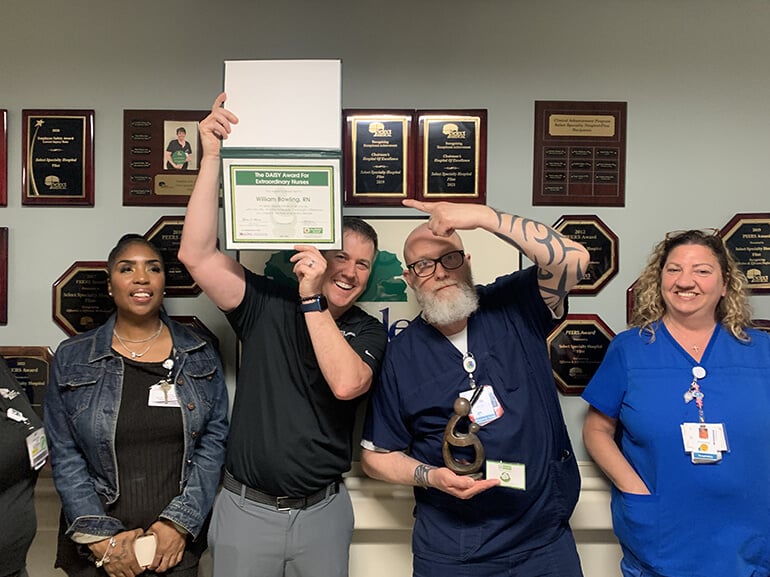
Time in a hospital is enough to spike anyone’s stress meter. But this Michigan family matriarch was prone to severe anxiety when she wasn’t connected to tubes and dazzled by flashing lights. She was looking for a dose of sanity soon after she arrived at the critical illness rehabilitation hospital.
Their nurse, Wil, brought it.
“Wil made sure he spoke to her with care and respect,” her daughters later wrote in their letter nominating him for Select Specialty Hospital – Flint’s annual DAISY award. “He explained things and kept her calm.”
During their stay, the family came to love and trust the soft-spoken big man with the tattoos. Somehow, he understood her – which was surprising since she was unable to speak during most of her stay because of her trach.
“He truly makes our mom feel seen and heard,” they wrote, “even though she can’t talk. He reads lips.”
And not only their mother’s.
Two years earlier, a flurry of nomination letters turned into the first of Wil’s two DAISY wins. They also praised Wil’s patience. How he never seems to rush. How he always answers every question and makes sure each patient and family member understands all the details.
You might, if you didn’t know him better, chalk the seemingly unflappable nerves of the man with the shaved head and busy chin to his training in the U.S. Marine Corps. But Wil said battlefield backbone is only part of his story; his ability to stay frosty through firestorms starts much earlier.
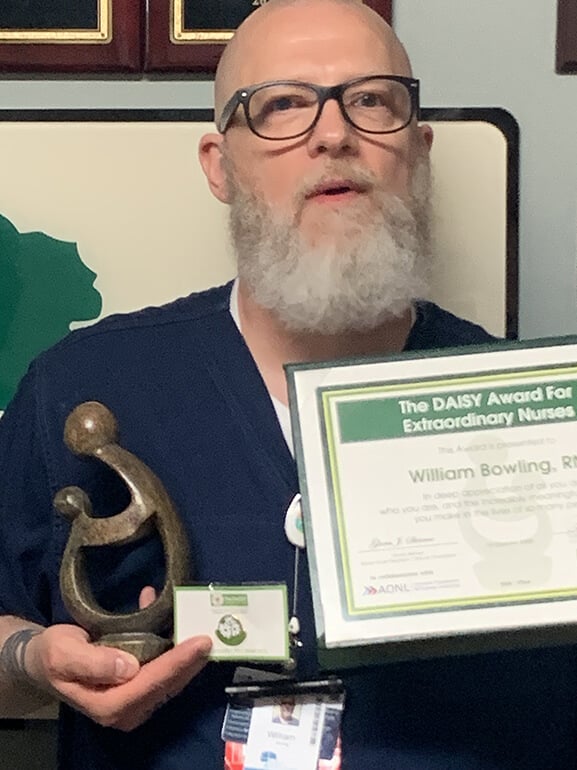
“I’m high ADHD,” he said. He was diagnosed with attention deficit/hyperactivity disorder as a kid and has always treated it without pills.
A characteristic of the disorder is hyper focus – moments of deep, uncontrollable concentration on specific tasks. Disabling for some, but Wil uses it to his advantage.
“Usually when chaos ensues, I always remain calm.” Wil said. “Always have. I can’t explain it. I just kind of zone in.”
At first, Wil’s ability to focus seemed to find a home in the Marines – even though he never saw combat. He was just finishing basic training in the early 1990s when the first Persian Gulf War ended, and the unit to which he was attached came home.
He left the military after six years and tried several careers on for size. He was a route sales representative for a uniform company, an investment advisor and an insurance salesman. Nothing seemed to excite him.
Then, his grandparents became ill, and Wil helped care for them. “I developed a morbid curiosity,” he said. He also connected with the nurses. The way the job seemed to lead in so many directions was appealing, so, not long after his 40th birthday, Wil opted to go back to school and obtain a nursing degree in 2019.
He chose Mott Community College in his hometown of Flint because it offered more hands-on opportunities than other programs he’d checked out. His first job was working in long-term care as a floor nurse.
“I made the right call,” Wil said. “I wish I had done it a few years sooner.” Suddenly problems seeking solutions filled his mind every day. In eight months, they made him an assistant director.
Then, in 2021, some friends told him of an opening at Select Specialty Hospital – Flint. Wil, ready for a change in scenery, made the move.
Working for a critical illness rehabilitation hospital deepened Wil’s love for the profession. “I haven’t had two days alike,” he said. On any given day, Wil might focus on bladder scans, or trach leaks, or food tubes or a hundred other issues that make actual differences with patients.
“I like the complexity of the cases,” he said. At Select Specialty Hospital – Flint, Wil said doctors consult with him on patients and welcome his input as they develop treatment plans.
“If I don’t see my doctors at least once a day, then I’m curious,” he said.
And the cases themselves aren’t all that different than what a nurse might encounter in an acute care hospital’s intensive care unit – patients with severe injuries and illness who need help. Here, however, the pace is more deliberate and controlled, Wil said, which makes it a perfect training ground. The lessons he’s still learning in Flint could be applied anywhere.
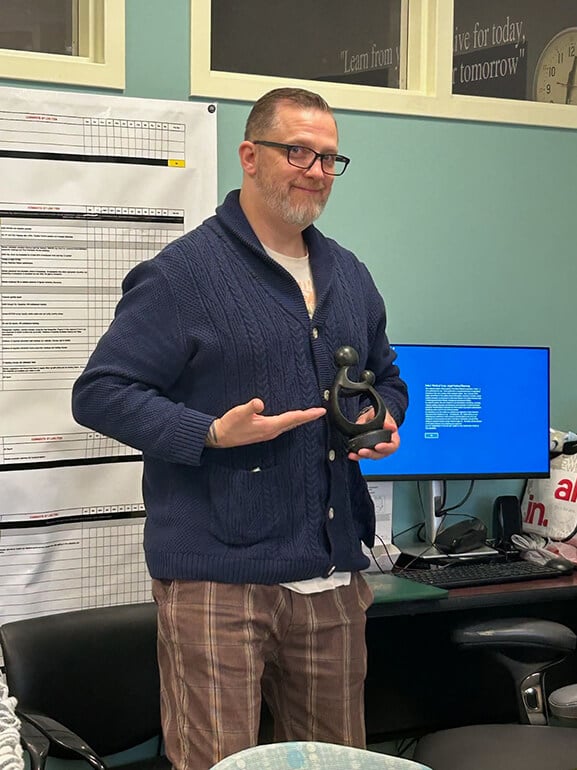
When Wil meets people interested in the profession, he suggests they start at a critical illness hospital as a nurse’s aide.
“It’s a good stepping stone,” he said. “It transitions to everything. If you can handle it in this hospital, you can handle it anywhere.”
Which means a world of opportunity for Wil to use his powers of patience, calm and focus to create connections that make all the difference.
“When you have been through as much as our mom in such a short amount of time,” one nominator wrote, “the nurse becomes like family.”